
Gamification, loyalty and personalisation can all improve digital banking engagement. But their effectiveness depends on the same thing: turning financial data into context a bank can act on.
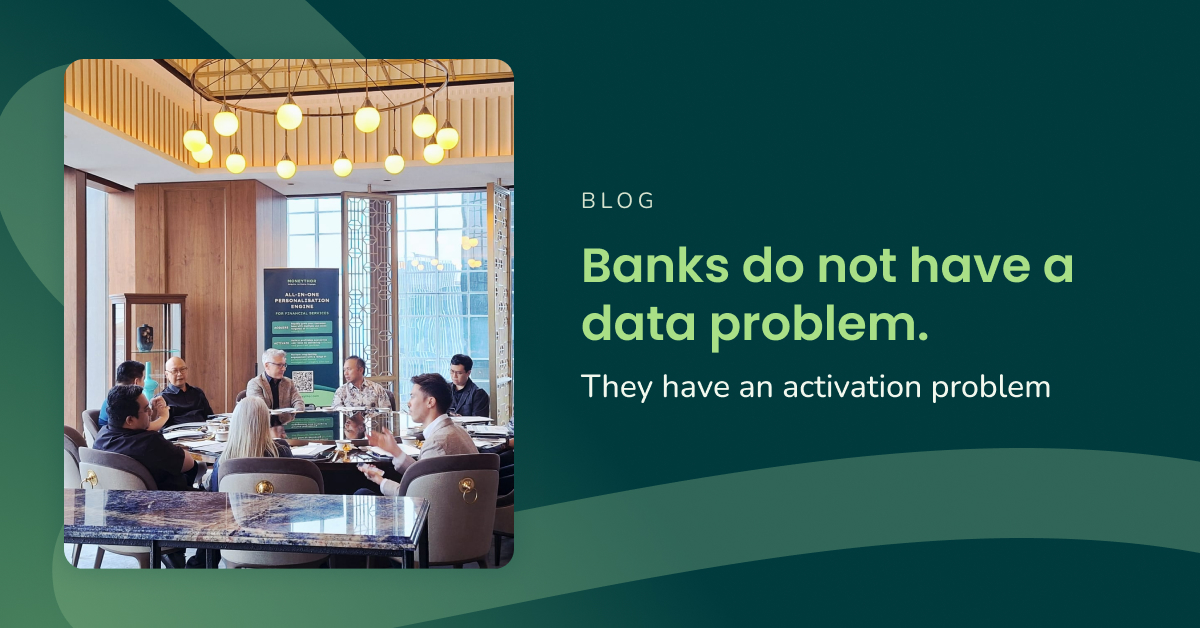
Moneythor and Soluix recently brought retail banking leaders together in Jakarta for a closed-door discussion on AI adoption and customer engagement.
Four assumptions came up often enough to be worth examining.
Can gamification create lasting engagement? Do engagement programmes make sense for customers with little disposable income? Does loyalty only become valuable as customers grow their balances? And when customers choose a primary bank, does the best offer ultimately win?
Each question points to a different part of the customer experience.
But underneath them sits the same constraint: a bank’s ability to understand what is happening in a customer’s financial life and act on it at the right moment.
That starts with the data.
Gamification works when it builds a financial habit
Gamification can lift engagement in banking when it is attached to a useful financial mechanic. When it is attached only to a reward, its effect tends to decay.
For banks serving younger customer bases, that distinction matters.
Indonesia’s median age is 30.7, with Gen Z and Millennials together accounting for roughly half of the population. Digital bank customer bases often skew younger still, making sustained engagement after acquisition a real challenge.
But there are two reasons banks should be careful about equating to a younger audience with more games.
First, attention and financial value are not necessarily held by the same customers. Generational research in Indonesia suggests that brands chasing Gen Z’s attention can overlook Millennials, who are currently at a life stage with greater consumer spending power and household financial influence.
Second, the mechanic matters more than the interface.
Research into mobile banking gamification consistently points to positive effects on engagement and financial behaviour. But badges, one-time bonuses and tier unlocks are not substitutes for genuine habit formation. Once the novelty or reward disappears, some of the behaviour it created disappears with it.
That gives banks a useful test before committing engineering time to a gamification initiative: if the mechanic were switched off tomorrow, would the customer still have a reason to continue the behaviour?
Indonesia’s own market provides good examples. Superbank’s Kartu Untung, built with KakaoBank, and Bank Saqu’s Tabungmatic round-up feature wrap engagement around genuine financial mechanics rather than points for points’ sake.
In each case, the game layer sits on top of something useful. Gamify the habit, not just the interface.
Further reading: Unpacking gamification in digital banking.
Mass-market engagement does not wait for a growing balance
Engagement programmes can work for customers whose income is flat. In Indonesia, those customers are not a niche segment. They represent a substantial part of the market.
Two assumptions from the Jakarta discussion belong together here. The first is that loyalty and engagement only pay off once a customer’s income or savings are growing.
The second is that mass-market customers with limited disposable income need different use cases.
Read side by side, the second answers the first.
Research drawing on World Bank and BPS figures finds Indonesia’s middle class shrank from 21.45% of the population in 2019 to 17.13% in 2024, while the aspiring middle class and groups below it represented a combined 185 million people by 2023.
The thin-margin customer is therefore not a segment requiring a side feature. It represents a huge part of the addressable retail banking market. OJK’s 2025 survey highlights another dimension of the problem. Financial inclusion stands at 80.51%, compared with financial literacy of 66.46%.
Most Indonesians now have access to financial services. A smaller share has the understanding and tools required to make the most of them. Access was the last decade’s problem, while usage is this one’s. That changes the role of engagement.
J-PAL’s review of savings interventions across low- and middle-income countries found that commitment savings products, voluntary arrangements people create to help themselves save, can help people living in poverty build savings even without rising incomes.
Grameen Foundation’s work with CARD Bank in the Philippines illustrates why. The bank initially assumed account opening was the problem. But acquisition was already working. The real problem came afterwards: 58% of newly opened accounts recorded zero transactions after opening.
What helped change behaviour was not simply a better financial incentive, but goal-setting and vivid, personalised savings goals. There is therefore a strong case that useful engagement matters more when income is constrained. A customer with a significant surplus can absorb a mistimed bill or an unexpected expense. Someone operating with little margin cannot.
The mechanics consequently need to change. Micro-goals can do the work that wealth accumulation does for customers with a surplus. Round-ups can replace large lump-sum contributions. Spend-pattern visibility, cash-flow forecasting and bill-timing nudges can provide more value than another cross-sell campaign.
That is not a lesser engagement strategy. It is a different one, designed around a different financial reality.
Why customers choose a bank: trust and convenience outrank rate
Does the best banking offer ultimately win? Usually, not by itself.
EY’s NextWave Global Consumer Banking Survey found trust in the primary financial relationship among Indonesian respondents was driven strongly by personal relationship factors, ahead of product-related factors.
Separate research into Indonesian bank selection points in a similar direction, while McKinsey research has highlighted the continuing importance of convenience even as digital adoption grows.
Rate still matters. Promotional savings rates can be extremely effective for gathering deposits, and they have helped fuel rapid growth among digital banks.
But there is a difference between attracting a balance and owning a relationship. Promotional-rate deposits can be rented rather than earned. When another provider offers a better return, rate-sensitive balances can move with them. The best offer can win a customer’s spare balance. It is less reliable at winning their primary financial relationship.
Convenience and ecosystem fit are increasingly important instead. EY found 70% of Indonesians are very or extremely interested in super-app-style, all-in-one financial experiences. Meanwhile, QRIS and open banking are making connected financial experiences increasingly normal.
Customers want fewer reasons to move between providers and applications to understand and manage their financial lives. The institution that becomes the place a customer understands, manages and acts on their money has a stronger opportunity to own that relationship.
A loyalty programme built primarily around competing on price is therefore competing on only one dimension of why customers stay.
Further reading: Launching loyalty programmes and campaigns that change behaviour.
The constraint underneath all three: activating financial data
These examples look like three different banking challenges. One is about gamification, another is about mass-market engagement, while the third one is about loyalty and the primary banking relationship.
But look at what each requires. A habit-forming savings experience needs to understand when the customer gets paid, their recurring commitments, their spending patterns, and what is likely to remain after those commitments. Engagement designed for volatile cash flow needs categorised transactions, detected recurring payments and a forward view of the month. Becoming the place where a customer manages their financial life requires a coherent picture assembled from accounts, cards, wallets and, increasingly, external financial sources.
Banks do not have a data problem. They have an activation problem.
The signals already exist inside transaction and customer data: they reveal intent, behaviour, habits and emerging needs. The challenge is turning those signals into context quickly enough to do something useful with them.
That is why financial data enrichment matters. A raw transaction description tells a personalisation engine relatively little. Enrichment can turn it into a recognised merchant, a spending category, a recurring subscription, a salary payment or a meaningful event within the customer’s monthly cash flow.
That context creates the foundation for the next decision. And every downstream experience inherits the quality of that foundation.
If a transaction is incorrectly categorised, the resulting insight can be irrelevant. If a recurring payment goes undetected, a cash-flow prediction becomes weaker. If financial context is incomplete, a supposedly personalised nudge begins to feel like another broadcast.
The objective is therefore not enrichment for enrichment’s sake. It is the journey from data to action.
From raw data to Deep Banking
Creating deeper banking relationships requires several capabilities to work together.
First, financial data needs to become context through enrichment, categorisation, recurring-payment detection, spend analysis and behavioural understanding.
Then, intelligence needs to interpret that context, evaluating events against the customer’s history and anticipating what might happen next.
Finally, the bank needs to act on that intelligence, orchestrating a relevant experience through the channel the customer is already using.
The sequence is simple: Data → Context → Intelligence → Action → Outcome
A signal arrives. The underlying data is enriched and the customer’s financial context changes. Intelligence evaluates the signal against that context. A relevant experience is selected and delivered. The outcome feeds what happens next.
This is the infrastructure behind what Moneythor calls Deep Banking: banking experiences that become more personalised, more proactive and capable of extending beyond traditional transactional banking.
Moneythor’s platform brings together financial data enrichment, predictive and generative AI, real-time decisioning and customer engagement capabilities so banks can move from detecting a financial event to acting on it within the same customer journey.
The distinction matters because customers do not experience “data enrichment”, “AI” or “decisioning” as separate technologies. They experience a bank noticing something relevant and helping at the right moment.
That might mean identifying surplus cash after payday and helping a customer move part of it towards a savings goal. It might mean recognising a recurring subscription and surfacing it before the next payment, or adjusting a savings target because a customer’s income is irregular.
Or it might mean triggering a relevant challenge, reward or recommendation based on something the customer has actually done.
Deep Banking begins when financial data stops being something a bank stores and becomes something it can act on.
What this means for a banking personalisation roadmap
For banks planning their next phase of personalisation, the sequence matters.
A common approach is to start with the experience: design the campaign, interface, loyalty mechanic or AI interaction and then determine what data is needed to make it work.
The stronger approach is the reverse. Start with the financial context required to make a useful decision. Then build the mechanic and design the experience around it.
Two practical steps can help.
-
Measure enrichment quality before designing the experience
Take a representative sample of transactions and establish how reliably they resolve to recognised merchants, correct categories and meaningful financial events.
That establishes the quality of the foundation on which personalisation will operate.
The objective is not simply to improve a data-quality metric. Ask what decisions become possible once the data can be trusted.
- Can the bank reliably identify salary?
- Can it distinguish recurring bills from discretionary spending?
- Can it detect subscriptions?
- Can it understand whether a customer is approaching a period of constrained cash flow?
Those are the signals that turn categorisation into customer value.
-
Start where enriched data changes a customer’s decision
Choose a use case in which financial context materially changes what happens next.
- A salary-triggered transfer into a savings goal.
- A subscription change surfaced before the next debit.
- A savings target that adapts to irregular income.
- A personalised challenge triggered by actual customer behaviour.
Each is relatively contained and measurable. More importantly, each fails visibly when the underlying context is wrong. That makes them useful places to prove value.
The strategic question is therefore not simply what experience should we build?
It is:
What financial context would allow us to create an experience our customers would notice if it disappeared?
Build the differentiation, not the plumbing
AI makes it easier than ever for banks to build new digital experiences. That does not necessarily mean every component underneath those experiences should be built from scratch. Real-time enrichment, event processing, financial analytics, decisioning, AI orchestration and multi-channel delivery all require infrastructure and ongoing maintenance.
The differentiating value for a bank is rarely the plumbing itself, but rather what the bank chooses to do with it. Banks should own the customer strategy, the propositions, the financial journeys and the experiences that make their brand different.
Platforms such as Moneythor provide the financial intelligence and orchestration layer underneath them, allowing internal teams to concentrate on building differentiated customer experiences rather than recreating the infrastructure required to deliver them.
Build where the bank can differentiate. Buy the foundation that lets it differentiate faster. Because as AI capabilities become increasingly accessible, access to models alone will not create an advantage.
Every bank can access increasingly capable AI. Every bank already has transaction data. The advantage lies somewhere narrower: how quickly a bank can turn its financial data into an interaction a customer would notice if it were taken away.
Frequently Asked Questions
Financial data enrichment turns raw financial data into information a system can reason about and act on.
For transaction data, that can mean turning an unstructured transaction description into a recognised merchant, spending category, recurring payment, salary event or other meaningful piece of financial context.
That enriched context can then support personalisation, cash-flow forecasting, recommendations, loyalty, gamification and other engagement use cases.
Every downstream decision depends on the context available to make it.
A nudge triggered by a miscategorised transaction can feel irrelevant. A missing recurring payment can weaken a cash-flow forecast. Poor merchant recognition can make spending insights confusing.
Better financial context enables banks to act on a more relevant signal at a more useful moment.
It can, particularly when gamification reinforces a useful underlying financial behaviour.
Savings goals, challenges, automated contributions and other mechanics can encourage repeated behaviour, while purely novelty-driven mechanics may lose effectiveness when rewards disappear.
The important question is not simply whether customers interact with the game, but whether the mechanic helps create a behaviour worth repeating.
Price and product remain important, but they are only part of the relationship.
Trust, convenience, personal relationships and the ability to manage more of a customer’s financial life in one place all influence primary-bank choice.
Promotional rates can attract deposits. Creating a useful everyday financial relationship gives customers more reasons to stay.