
Banks Have the Data. The Problem is Acting on It
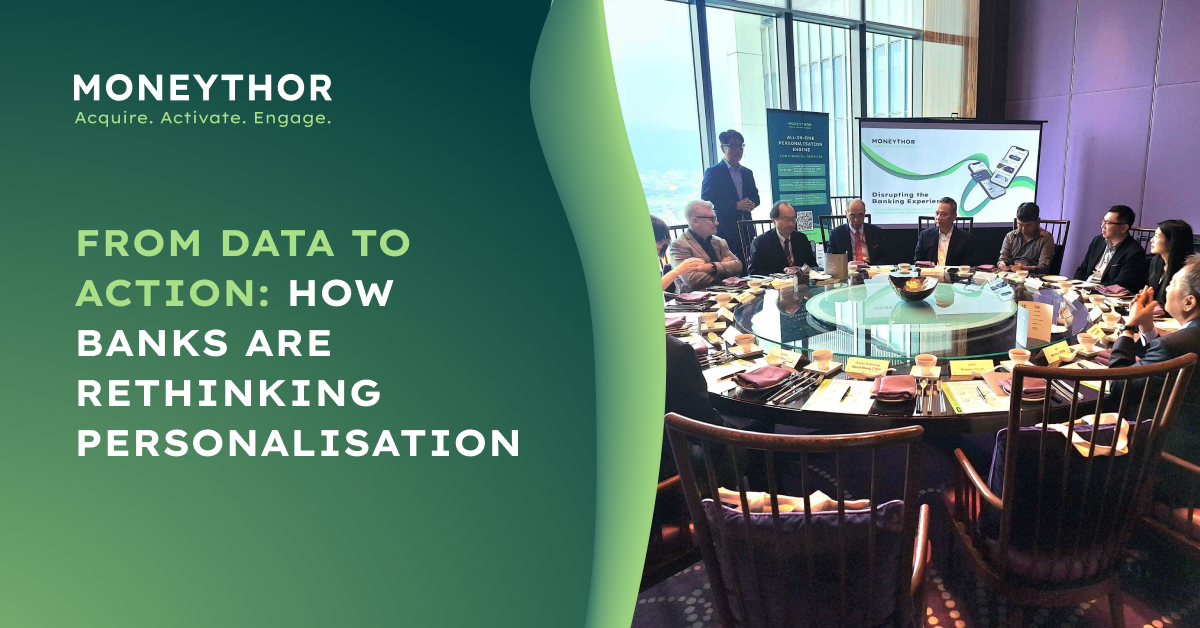
Personalisation has become one of the most discussed priorities in banking, yet for many institutions, it remains frustratingly out of reach Conversations at a recent Moneythor event in Taiwan made this tension vivid. Banks are not short of data, nor are they lacking ambition. The challenge lies in connecting the two in a way that drives meaningful, real-time customer engagement.
A familiar pattern emerged across the room. Banks described complex technology environments shaped by years of incremental change – new digital layers sitting atop legacy cores, customer data scattered across multiple systems, and no single, unified view of the customer. Integrating these environments is rarely straightforward, particularly when customers expect consistency across mobile, online, and every other touchpoint as a baseline. It is no surprise that so many institutions struggle to build a complete, real-time view of the customer when the underlying data remains fragmented. As Moneythor has observed across client deployments spanning multiple geographies, the most persistent integration challenge is not connecting to the bank’s digital channels. It is getting quality, timely data from back-end systems of record into a state where it can actually be used.
In some cases, different transaction types, commercial cards, overseas remittances, domestic accounts, foreign currency accounts, live in entirely separate systems, each with its own format, protocol, and latency profile. The result is a patchwork of data that is difficult to enrich, harder to act on, and nearly impossible to deliver in real time.
The Shift Toward Modular Transformation
What is changing is how banks are choosing to address this problem. Rather than pursuing large-scale transformation programmes that attempt to replace existing infrastructure, there is a growing preference for targeted, modular approaches. The concept of a Value-Added Function Block (VAFB) is gaining traction – the idea of enhancing what already exists rather than rebuilding the entire stack. banks prefer building blocks that integrate into their complex “systems of systems,” leveraging existing data to generate new insights, automate tasks, and deliver intelligent services. This reflects a broader shift in thinking: institutions are prioritising speed and adaptability, choosing to build differentiation on top of proven, configurable foundations.
At its core, this is precisely what the Moneythor engine is designed to do. It is a high-performance, scalable event-processing and orchestration platform that ingests real-time and batch data from a wide range of sources (accounts, cards, digital wallets, and Open Banking feeds) and transforms that raw data into enriched, actionable intelligence. Rather than replacing the bank’s existing infrastructure, it sits alongside it, making the most of what is already there.
From Raw Data to a Single Source of Truth
Even with the right architectural approach, the conversation quickly returns to data quality. The ambition is not simply to collect more of it, but to make it usable.
Banks at the roundtable spoke about the need to unify siloed data sources into something coherent: a single source of truth that allows them to understand customers in context, not in fragments. This is where many initiatives stall. Raw data rarely delivers value on its own. It needs to be enriched, structured, and continuously updated before it can support meaningful engagement.
The Moneythor engine addresses this through AI-powered transaction categorisation and enrichment, using machine learning models including multinomial logistic regression and text similarity techniques to automatically classify and contextualise every customer interaction. It also applies time-series forecasting and pattern recognition to predict cashflow, identify recurring transactions, and flag upcoming financial events. The result is not just cleaner data, it is data that is ready to act on.
From campaigns to real-time customer context
The more compelling shift lies in what happens next. Insights alone are not enough. Dashboards and analytics may describe customer behaviour in detail, yet they do little to influence it unless they are connected to action.
The focus is moving towards systems that can anticipate what a customer might need and recommend, or even initiate, the next best step. This is where AI begins to demonstrate tangible value, particularly when predictive models are combined with prescriptive logic to move from observation to execution.
Within Moneythor’s platform, this translation from data to action happens in real time. Everyday financial activity becomes personalised recommendations, contextual messages, and intelligent interventions delivered at the moment they matter most:
- A salary arrives -> trigger a savings nudge.
- An unusual spend appears -> send a timely alert.
- A savings goal edges closer -> celebrate the milestone and encourage the next step.
Each of these is a signal. Each one is an opportunity to say something genuinely useful.
Clients using Moneythor have reported engagement levels up to 10 times higher than with legacy communication methods. Where traditional banking banners rarely exceed 1–2% engagement, personalised insights generated by the Moneythor engine consistently drive between 15% and 30% engagement rates, with specific use cases such as savings insights reaching 26% and fee-related insights reaching 33%.
Empowering Business Teams to Move at the Speed of Behaviour
Speed plays a critical role in making this shift viable. Many banks at the roundtable highlighted the difficulty of launching and iterating on campaigns within existing processes, where reliance on IT teams and release cycles slows down the ability to respond to customer needs.
There is a clear appetite for tools that place more control in the hands of business users., With Moneythor Studio, the solution’s no-code and low-code back-office tool, business analysts and marketers can design, test, launch, pause, and refine personalised experiences in full autonomy, without technical dependency on the Moneythor team or the bank’s internal IT function.
Deep Banking: Personalisation as a Continuous Capability
Underlying all of these discussions is a broader redefinition of what personalisation means in banking. It is no longer confined to targeted offers or improved segmentation. It extends into something more ambitious – a model where the bank becomes proactive, context-aware, and genuinely relevant in the daily financial lives of its customers.
This is the essence of what we call Deep Banking – a philosophy built on three pillars:
- Personalisation: financial services tailored to each individual’s needs, preferences, and goals. In a world where customers expect relevance, personalisation is no longer a differentiator, but a baseline expectation.
- Proactivity: shifting from reactive to proactive engagement by anticipating customer needs before they arise, rather than waiting to be asked.
- Beyond Banking: extending the bank’s role into wider aspects of customers’ lives, integrating lifestyle value that goes beyond transactions.
Enabled by a full spectrum of AI, from predictive insights and generative content to conversational assistants and agentic capabilities, Deep Banking helps customers feel seen, understood, and supported throughout their journey.
The Real Challenge
The conversations in Taiwan reflected an industry that is moving decisively in the direction of Deep Banking, while still navigating the practical constraints of legacy systems and entrenched processes. Progress depends less on grand transformation initiatives and more on the ability to connect data, intelligence, and execution in a seamless and scalable way.
Banks that succeed will be those that treat personalisation not as a standalone feature, but as a continuous capability, one that grows smarter with every customer interaction, and evolves alongside the people it serves. In that context, the real challenge is no longer understanding the value of personalisation. It is about how quickly it can be embedded into everyday banking experiences in a way that feels natural, timely, and genuinely useful.