
Malaysia’s Open Finance Moment Is Now Close Enough to Plan For
For several years, open finance in Malaysia has been a policy conversation, but having now moved through consultation, banks across the region are putting together their implementation plans.. The technical foundations are being built, and phased participation is expected to start with the larger institutions before extending across the wider market.
The mechanics matter less than the shift they create. Under a mature open finance model, every participant does two things rather than one: it shares data out on the customer’s instruction, and it pulls data in from other providers to enrich its own view of that customer. An institution that has spent decades as the custodian of its own customer data also becomes a consumer of everyone else’s.
Whilst this might start with larger institutions, it’s something all regional banks should keep a close eye on. Whilst there was much to learn from Europe’s roll out, Malaysia, will put its own flavour to Open Banking, which should be embraced as a customer-centric movement, rather than a regulatory burden.
How banks use open finance data will matter more than how much they have access to
When the same consented data is available to every participant, advantage no longer sits with whoever holds the most of it. It sits with whoever does the most useful thing with it.
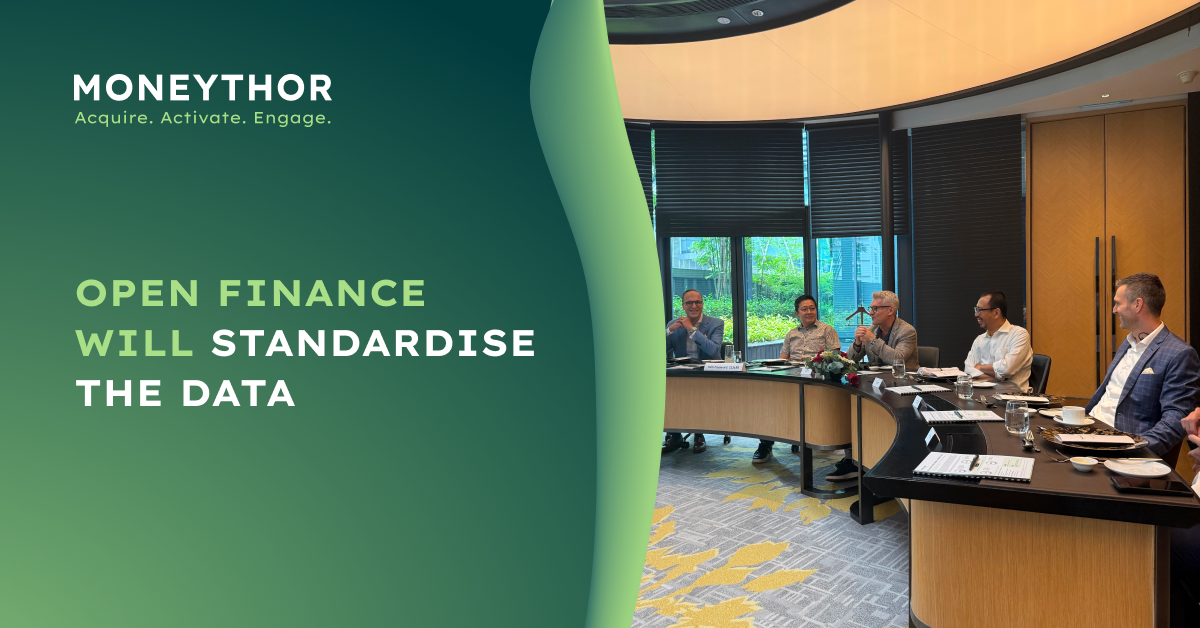
Conversations at a recent Moneythor executive roundtable in Kuala Lumpur made that tension concrete. The senior banking leaders in the room were, on balance, optimistic about open finance. They were also clear-eyed about what it will not solve on its own.
Banking data needs a clean-up to support open finance opportunities
The first point raised, and the one that kept resurfacing, was unglamorous: open finance will only work if the underlying data engineering works. If the data is not engineered correctly in the background, whatever is built on top of it will not hold.
This is not a hypothetical risk. Participants described customer data that is not organised inside the bank at all, which puts a hard ceiling on what can be delivered to the customer. The most visible symptom is also the most familiar: the same customer being asked, repeatedly, for information the bank already holds. Open finance will add more data into that environment but it won’t clean it up.
Consent is the Easy Part. Activation is Where Open Finance Fails
Malaysia’s model is permission-based, and nothing moves without the customer’s explicit consent. That design is right, and it creates two questions the roundtable returned to repeatedly. How do banks persuade customers to opt in? And once they have, what happens next?
The second question decides the outcome. Weak activation is one of the reasons open finance underdelivered in other markets. A consent flow that leads to a slightly fuller account aggregation screen is not a reason for anyone to keep the permission switched on.
Banks at the table observed that younger segments are noticeably more willing to share data when there is something tangible in return, with merchant rewards the clearest example. The exchange must be immediate and legible: here is what I get, and here is what it cost me.
The engagement numbers explain the urgency. In the FinTech Futures and Moneythor report, Closing the Gap, retail banking leaders reported an average customer drop-off rate of 13%, with 79% of banks seeing drop-off somewhere between 5% and 30%. If customers disengage before the relationship deepens, acquisition costs rise while lifetime value falls. Adding a data-sharing consent to an experience that already loses customers changes nothing.
PFM Is the Baseline, Not the Product
Personal financial management is the natural first use case, because consolidating accounts into a clearer view is what customers immediately notice. But as one theme from the roundtable put it, PFM is just the baseline. It is what gets built on top of it that moves the needle and drives revenue.
Customers already receive financial guidance from apps, comparison sites and general-purpose AI assistants. What they still want, and what nobody has convincingly delivered, is a single place to manage their money. That is the genuine open banking opportunity, and it is also where the risk of disintermediation sits. As AI takes on more of the work of managing someone’s finances, the question of who keeps the relationship becomes urgent, and it comes back to data engineering before it comes back to AI.
The industry is a long way from that today. The same report found that AI or advanced analytics currently personalise an average of 38% of customer interactions, that only 8% of banks deliver highly personalised journeys across most touchpoints, and that just 6% have achieved fully individualised real-time experiences.
What closes that gap is not more dashboards. It is the translation of everyday financial signals into action, delivered at the moment they are useful. With cross-institution data in play, the signals get considerably richer:
- A recurring subscription running from an account at another bank, quietly renewing at a higher price, becomes a saving the customer can act on in one tap.
- A cash flow forecast built across two institutions shows a shortfall three days before a direct debit, so the warning arrives while there is still time to do something about it.
- Idle balances in a low-yield external account become a relevant, well-timed conversation about a better product rather than a generic campaign.
Each of those is a signal, and each is an opportunity to say something genuinely useful. Clients using Moneythor have reported engagement levels up to ten times higher than legacy communication methods, with personalised insights consistently driving engagement rates far beyond what a traditional in-app banner achieves.
The Loyalty Paradox: More Data In, Easier Switching Out
Open finance is not a one-way benefit, and the room said so plainly. In markets that have already been through this, easier data portability supported consolidation of the customer view and made switching materially easier at the same time. Malaysian banks stand to gain a broader picture of the customer while lowering the cost of leaving.
That sharpens the loyalty question rather than answering it. Two-thirds of banking leaders surveyed for Closing the Gap, 65% to be precise, believe customers will switch banks within the next two years if their expectations are not met. Yet the same leaders rate their own ability to meet modern customer expectations at just 6.3 out of 10, and only 12% score their institution 9 or 10. The three weakest areas they identified are consistent omnichannel experiences, relevant and personalised engagement, and proactive financial guidance. Those are precisely the capabilities that determine whether a customer stays once switching becomes frictionless.
Deep Banking: What Comes After Compliance
Underneath all of this sits a broader redefinition of what personalisation means in banking. It’s no longer a matter of better segmentation or better-targeted offers. It describes a bank that is proactive, context-aware and genuinely relevant in the daily financial lives of its customers.
This is the essence of what we call Deep Banking, a philosophy built on three pillars:
- Personalisation: financial services tailored to each individual’s needs, preferences and goals. Where relevance is expected, this is a baseline, not a differentiator.
- Proactivity: anticipating customer needs before they arise rather than waiting to be asked.
- Beyond Banking: extending the bank’s role into wider aspects of customers’ lives, through rewards, referrals, loyalty and lifestyle value that goes beyond the transaction.
Enabled by a full spectrum of AI, from predictive insights and generative content to conversational assistants and agentic capabilities, Deep Banking is how consented data becomes something the customer actually feels. The commercial case follows: Moneythor clients report an average 25% increase in active customers and up to 2.5 times more in savings deposits.
The Real Challenge
The mood in Kuala Lumpur was pragmatic rather than transformational, and deliberately so. Participants described a familiar arc in which initial excitement fades as legacy systems and data quality drag progress down. The response was not a call for another five-year programme.
To close out the discussion, Martin Frick, CEO of Moneythor said:
“Work towards improving a small piece of the current state of play. Step by step, little by little, in a way that culminates in wider change over time.”
It’s not an argument for low ambition but an argument for sequencing: pick the part of the journey where better data and better decisioning produce a visible customer outcome, ship it, measure it, and use it to fund the next one. That approach also matches how banking leaders now weigh risk. In the same survey, 67% said moving too slowly to meet customer expectations is a greater danger than choosing the wrong technology.
Open finance will standardise the plumbing. The banks that win will be the ones who turn shared data into a better everyday experience, not the ones who simply comply.