
Ask a room of banking leaders whether they understand their customers and most will say yes, with good reason. Transaction data, app behaviour and product holdings give a bank a clearer view of someone’s financial life than almost any other business has. Ask the same room how much of that understanding reaches the customer, at the moment it would help, and the answers become more careful.
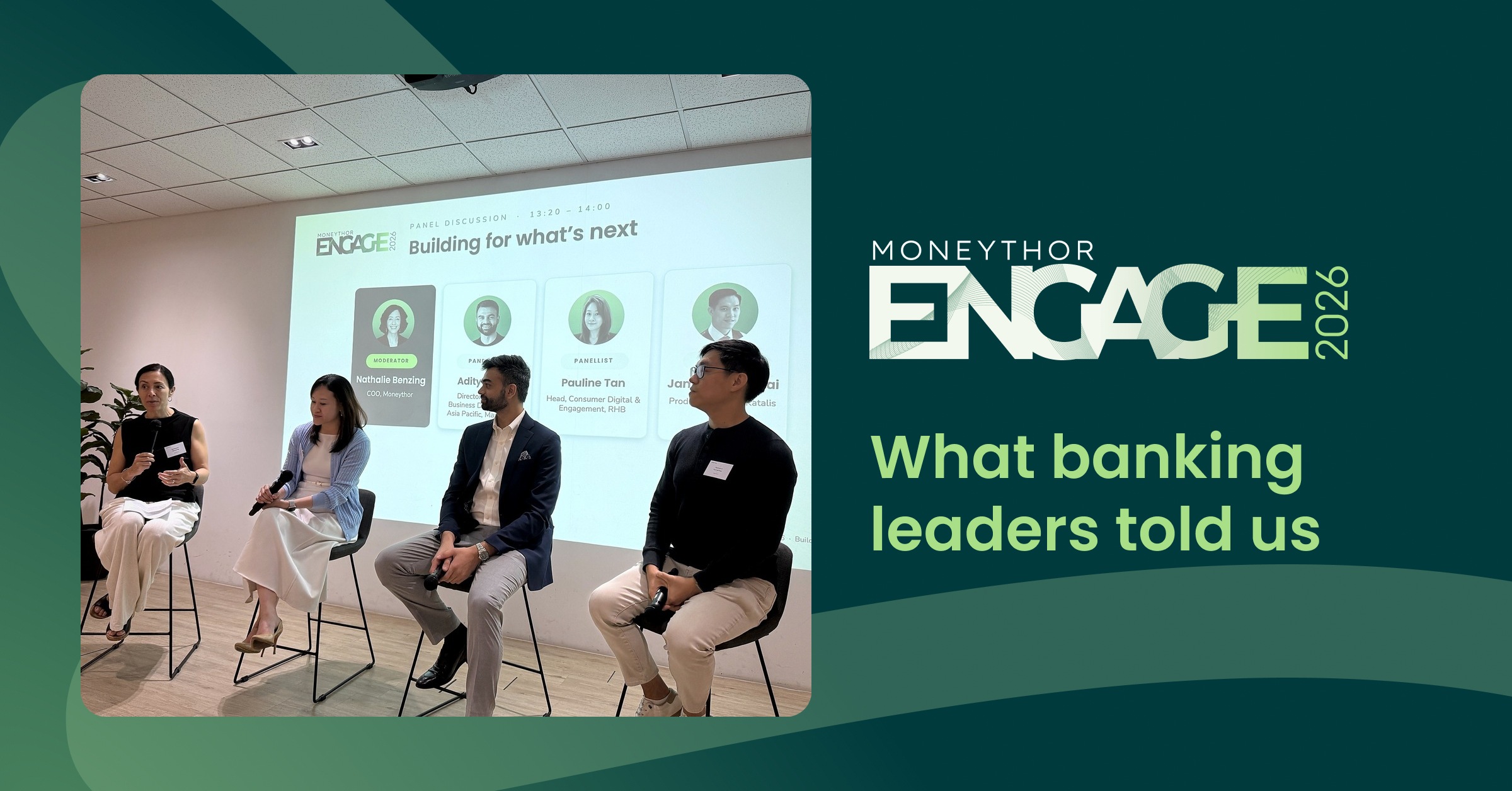
That distance was the subject of Engage 26, which Moneythor hosted in Singapore on 17 November, the day before Singapore Fintech Festival. Under the theme Build to Anticipate, leaders from FAB, RHB Bank, DKatalis, Mastercard, AWS and Korn Ferry spent the afternoon on one practical question: what does it take to move from understanding customers to engaging them before they ask?
The answer turned out to be less about technology than many expected. Technology matters, and nobody argued otherwise. But session after session arrived at the same place from a different direction. The problems left to solve sit mostly in how banks prioritise, organise, measure and decide.
Good data and basic insights are now hygiene
The panel, moderated by Moneythor COO Nathalie Benzing with Aditya Sant (Mastercard), Pauline Tan (RHB Bank), Jamorn Horathai (DKatalis) and Anjul Ray (AWS), started by lowering the bar on what counts as progress.
Clean, categorised transactions and simple spending insights used to be a differentiator. Now customers expect them. A bank that gets them right has met the standard, not raised it.
The ambition the panel set instead was a true segment of one: personalisation that runs all the way through, from the experience a customer sees in the app to the product they’re offered next. The panellists were honest that the industry is still a long way from that. AI has real potential to close the gap, they agreed, but only for banks that have the basics in place first.
That honesty matches what banks say about themselves. In Closing the Gap, the research Moneythor published with FinTech Futures, retail banking leaders rated their own ability to meet customer expectations at 6.3 out of 10, and only 6% said they personalise in real time.
Azfar Thaha of AWS put the obligation plainly when we spoke to him afterwards: “Banks have a responsibility to customers, because of all the data they have, to really create a segment of one.”
Run the customer experience as a product, not a project
The customer spotlight brought that ambition down to a single bank. Rudy Sudarsono, SVP and Head of Products, Cards, and Alan Francis, Head of Digital, described how FAB moved from understanding its customers to engaging them, in a conversation moderated by Thomas Alex of Mastercard.
FAB’s story was as much about focus as technology. The team identified the “big rocks”, the few things that would matter most, and re-prioritised so its energy went into them rather than being spread across everything.
They also changed what they called the work. It stopped being a project and became a product. The distinction is more than language. A project is delivered and handed over. A product is owned, measured and improved for as long as customers use it, and the customer experience behaves like the second, whether a bank organises for it or not.
On AI, FAB’s view was measured. The use cases matter, but they have to move at the pace customers are ready for. To keep the work funded, the team relied on small wins: showing the board early, visible success so the programme kept its sponsorship and its momentum.
Azfar Thaha drew the same lesson: “Your products are not static anymore. A digital experience is a live product that you need to manage on an ongoing basis.”
The blockers banks chose were organisational
The most revealing moment of the afternoon came from the attendees themselves. Before Navin Wathan, Senior Partner at Korn Ferry, opened his session on organising to deliver, the room voted on the blockers it most wanted to work through.
Three came out on top: ownership, KPIs and data access.
Each got its own round. Navin opened with examples of how other industries have handled the same problem, some well and some badly, before tables worked through it and compared how their own banks are approaching it.
What stands out is the list itself. Nobody voted for model selection or vendor choice. Even data access, which sounds technical, was framed as an organisational question: who is allowed to use the data, for what, and who answers for the result.
The interviews after the sessions said the same. “The first challenge is data,” Azfar told us. “How do you clean it, contextualise it and use it? Number two is a mindset change. Banks are used to operating in a certain way, marketing in a certain way, talking to customers in a certain way.”
Aivin Lim, Digital Product Owner at RHB, pushed the point further: “Even if we have the data, do we use it meaningfully? Data can point you towards how a customer behaves, but what matters is what is meaningful to them at that point in time.”
That last phrase is a useful test for any personalisation programme. Relevance has a timestamp.
The customer may not always arrive through the app
One theme looked further ahead. Thomas Alex of Mastercard left with this as his main takeaway: “Agentic applications are coming into consumer banking. Consumers are going to start using their own personal agents to work with their banks.”
If that happens at any scale, several assumptions change at once. The banking app stops being the only front door. Decisions a customer once made by tapping through a journey may be delegated to software acting for them. And a bank’s controls, from consent to limits to auditability, have to hold up when the party on the other side is an agent rather than a person.
Five moves for 2027
Vivek Seetharaman, VP Product at Moneythor, closed the afternoon with five moves for banks to build into 2027 planning.
- The front door is moving. How people interact with their bank is changing, and the app is no longer guaranteed to be where that happens.
- The ROI mandate. Investment in engagement has to prove its return. Echoing FAB’s small wins, value needs to be visible early, not promised for year three.
- Intelligence inside the channel. Insight only helps when it shows up where the customer already is, in the moment, not in a separate dashboard or next week’s campaign.
- Agents will start moving money. Banks need to plan for customers who act through agents, and for what that means for journeys and decisioning.
- The governance mandate. As more decisions are automated, banks need clear, bank-defined rules for what AI can do, when, and with whose approval.
What the afternoon added up to
Engage 26 did not end with a call to collect more data or buy more AI. It ended closer to the opposite. Banks already know a great deal about their customers. What separates the banks making progress is whether that knowledge has an owner, a number it is measured against, and a route to the customer while the moment still matters.
That is the idea behind Deep Banking: experiences that are personalised, proactive and extend beyond the transaction, built on a layer that turns financial events into decisions and interactions in the channels customers already use. The room’s reminder was that the layer only pays off when someone inside the bank owns what it delivers.
The question for 2027 is not whether a bank understands its customers. It is whether that understanding is allowed to act.
Pick the move closest to your 2027 plan and we’ll work through it with your team in a 90-minute session. Book a working session.